aster.cloud aster.cloud
  • /
  • Platforms
    • Public Cloud
    • On-Premise
    • Hybrid Cloud
    • Data
  • Architecture
    • Design
    • Solutions
    • Enterprise
  • Engineering
    • Automation
    • Software Engineering
    • Project Management
    • DevOps
  • Programming
    • Learning
  • Tools
  • About
  • /
  • Platforms
    • Public Cloud
    • On-Premise
    • Hybrid Cloud
    • Data
  • Architecture
    • Design
    • Solutions
    • Enterprise
  • Engineering
    • Automation
    • Software Engineering
    • Project Management
    • DevOps
  • Programming
    • Learning
  • Tools
  • About
aster.cloud aster.cloud
  • /
  • Platforms
    • Public Cloud
    • On-Premise
    • Hybrid Cloud
    • Data
  • Architecture
    • Design
    • Solutions
    • Enterprise
  • Engineering
    • Automation
    • Software Engineering
    • Project Management
    • DevOps
  • Programming
    • Learning
  • Tools
  • About
  • Automation
  • Engineering
  • Technology

IT Prediction: The Vast Majority Of Security Operations Workloads Will Be Automated

  • aster.cloud
  • January 13, 2023
  • 3 minute read

Editor’s note: This post is part of an ongoing series on IT predictions from Google Cloud experts. Check out the full list of our predictions on how IT will change in the coming years.


Partner with aster.cloud
for your next big idea.
Let us know here.


From our partners:

CITI.IO :: Business. Institutions. Society. Global Political Economy.
CYBERPOGO.COM :: For the Arts, Sciences, and Technology.
DADAHACKS.COM :: Parenting For The Rest Of Us.
ZEDISTA.COM :: Entertainment. Sports. Culture. Escape.
TAKUMAKU.COM :: For The Hearth And Home.
ASTER.CLOUD :: From The Cloud And Beyond.
LIWAIWAI.COM :: Intelligence, Inside and Outside.
GLOBALCLOUDPLATFORMS.COM :: For The World's Computing Needs.
FIREGULAMAN.COM :: For The Fire In The Belly Of The Coder.
ASTERCASTER.COM :: Supra Astra. Beyond The Stars.
BARTDAY.COM :: Prosperity For Everyone.

Prediction: By 2025, 90% of security operations workflows will be automated and managed as code

There is not enough funding, resourcing, skills, or broadly applicable solutions to help manage security risk effectively across modern technology environments. Organizations are struggling to identify which alerts and security areas to prioritize while moving quickly through their digital transformation. This challenge is compounded by an exponential increase in data volume, alert fatigue, financial costs, and overall complexity. To combat this, organizations are looking to drive better developer hygiene, leverage more managed services and cloud-native capabilities, use products and solutions that provide greater security-by-default, and shift to security engineering over operations, to manage risk at scale.

Security operations — traditional detection and response workflows — are notoriously overburdened with toil. There are quite simply too many events and not enough people to scale them. Legacy tools coupled with a high bar for security engineering have made it very difficult for organizations to build effective, scalable solutions to manage threats in modern technology environments. As a result, there’s a cybersecurity talent shortage of over 700,000 jobs, which will likely increase and never be filled.1

This new 90/10 split predicted between automated and manual detection and response events can allow security operations teams to focus on their critical security work: threat research and operationalizing threat intelligence, proactive hunting, solving for visibility challenges, maturing alert triage and response automation capabilities, and more importantly, shifting security operations knowledge “left.” This last point can drive a deeper relationship with developers and improve the preventive security of the overall infrastructure.

Read More  Understanding Transactional Locking In Cloud Spanner

To achieve this vision, we’ve developed the Autonomic Security Operations (ASO) framework, a holistic and novel approach to modernizing people, processes, and technologies – enabling organizations to adopt Google’s cloud-scale engineering approach to threat management. This framework underpins our substantial technology investments in Chronicle Security Operations, VirusTotal, Mandiant, and beyond.

At the core of ASO is Continuous Detection, Continuous Response (CD/CR), a model we’ve developed for traditional security operations teams to help shift away from the assembly-line approach to managing threats and adopt an agile operating model centered around establishing continuous feedback loops across the core areas of detection and response, in order to objectively and iteratively improve an organization’s security capabilities. It’s heavily grounded in our own approach to security as well as other methodologies, such as DevOps, SRE, Detection Engineering, and Agile.
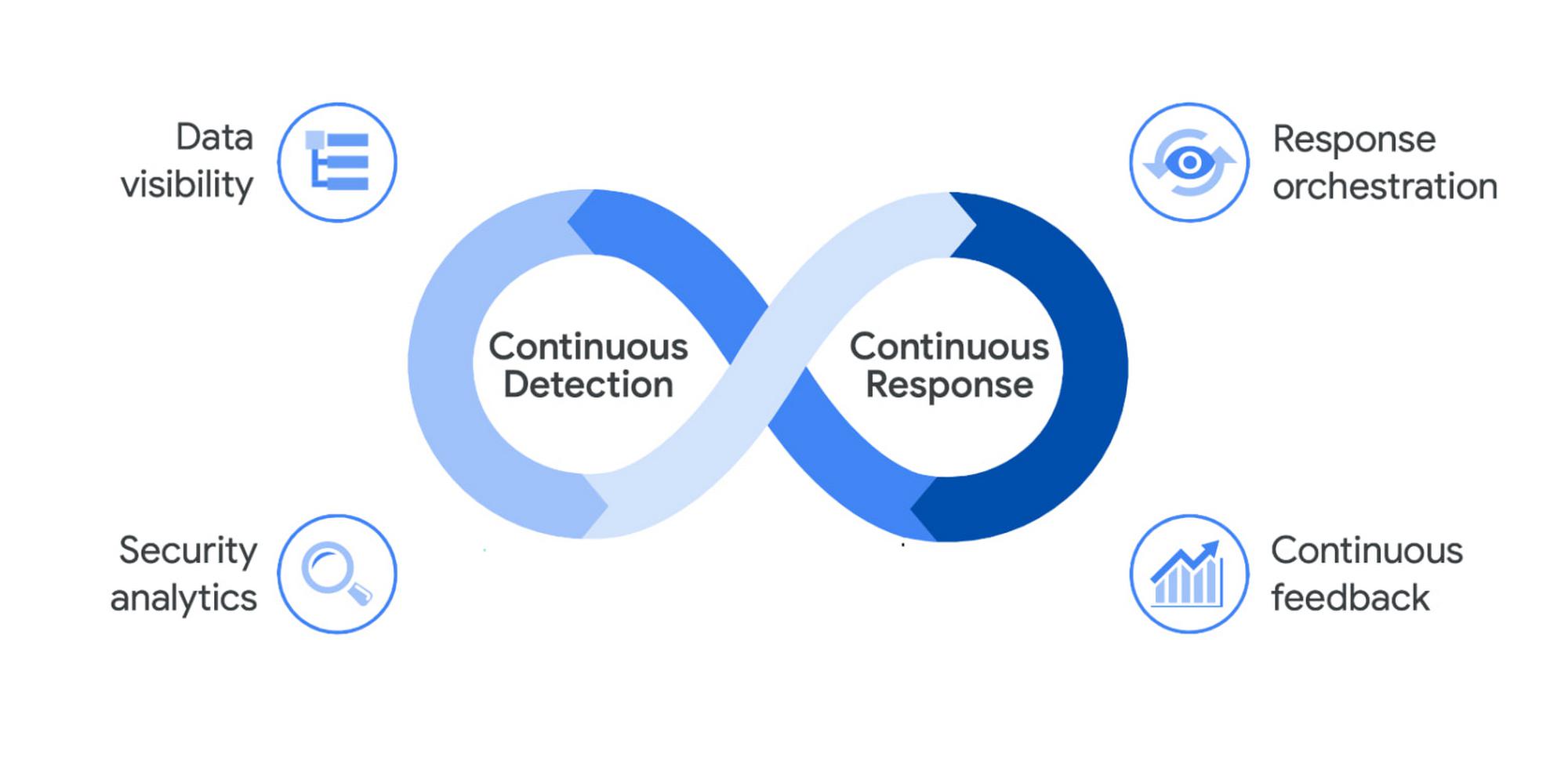
Some examples of the CD/CR model include:
Taking an API-first approach to security operations. We’ve heavily invested in developing APIs for most aspects of Chronicle Security Operations, allowing organizations to codify their approach to threat management from instantiating visibility, developing and deploying security analytics, creating response automation playbooks, and deploying dashboards, to tracking KPIs.
Deploying security analytics as-code. While we’re developing curated built-in detections in Chronicle Security Operations and native threat-detection capabilities through Security Command Center, we’re also fostering community collaboration on developing security analytics in our Community Security Analytics repository. These analytics can be deployed as-code across Chronicle and other analytics tools in Google Cloud.In order for security operations teams to become an autonomic function of their organizations and scale across the threats their businesses face, they will need to adopt modern, developer-friendly workflows like CD/CR, which can free them to prioritize the most important threats to their organizations.If you’d like to learn more about Google Cloud’s approach to automating security operations, start with the white paper Autonomic Security Operations: 10X transformation of Security Operations Center and watch our latest ASO webinar.

Read More  Introducing Cloud Analytics By MITRE Engenuity Center In Collaboration With Google Cloud


1.Announcement of White House National Cyber Workforce and Education Summit 

By: Iman Ghanizada (Global Head of Autonomic Security Operations)
Source: Google Cloud Blog


For enquiries, product placements, sponsorships, and collaborations, connect with us at [email protected]. We'd love to hear from you!

Our humans need coffee too! Your support is highly appreciated, thank you!

aster.cloud

Related Topics
  • Automation
  • Autonomic Security Operations
  • Google Cloud
  • Security
You May Also Like
View Post
  • Data
  • Technology

Synthetic data could ease people’s concerns about privacy breaches. But who gets to create it?

  • September 15, 2026
View Post
  • Computing
  • Multi-Cloud
  • Technology

Multi-cloud with AWS and Azure just got a whole lot easier thanks to a new interconnect service

  • September 2, 2026
View Post
  • Computing
  • Multi-Cloud
  • Technology

VMware targets ‘three core AI cost drivers’ with new Private AI Cloud service

  • September 2, 2026
View Post
  • Computing
  • Multi-Cloud
  • Technology

Agentic AI is spurring a ‘fundamental shift’ in cloud infrastructure consumption

  • August 17, 2026
View Post
  • Computing
  • Multi-Cloud
  • Technology

Why real SaaS resilience means breaking free of the hyperscaler

  • August 11, 2026
View Post
  • Computing
  • Multi-Cloud
  • Technology

Broadcom eyes security, performance boosts with vDefend and Avi Load Balancer updates

  • August 7, 2026
View Post
  • Technology

IBM Study: One in Four Malicious Breaches are AI-Enabled, Costing Companies $6 Million on Average

  • July 29, 2026
View Post
  • Technology

3 Questions: Neural transparency and the future of AI design

  • July 17, 2026

Stay Connected!
LATEST
  • 1
    Synthetic data could ease people’s concerns about privacy breaches. But who gets to create it?
    • September 15, 2026
  • 2
    Apple Flagship Hardware Launch for September 2026
    • September 10, 2026
  • 3
    Multi-cloud with AWS and Azure just got a whole lot easier thanks to a new interconnect service
    • September 2, 2026
  • 4
    VMware targets ‘three core AI cost drivers’ with new Private AI Cloud service
    • September 2, 2026
  • Agentic AI is spurring a ‘fundamental shift’ in cloud infrastructure consumption
    • August 17, 2026
  • Why real SaaS resilience means breaking free of the hyperscaler
    • August 11, 2026
  • 7
    Digital sovereignty in the age of AI: You don’t have to choose between control and innovation
    • August 10, 2026
  • 8
    Broadcom eyes security, performance boosts with vDefend and Avi Load Balancer updates
    • August 7, 2026
  • 9
    IBM Study: One in Four Malicious Breaches are AI-Enabled, Costing Companies $6 Million on Average
    • July 29, 2026
  • 10
    Accelerating the frontiers of scientific discovery: Google’s $40M commitment to the Genesis Mission
    • July 26, 2026
about
Hello World!

We are aster.cloud. We’re created by programmers for programmers.

Our site aims to provide guides, programming tips, reviews, and interesting materials for tech people and those who want to learn in general.

We would like to hear from you.

If you have any feedback, enquiries, or sponsorship request, kindly reach out to us at:

[email protected]
Most Popular
  • 1
    3 Questions: Neural transparency and the future of AI design
    • July 17, 2026
  • 2
    Intel Invests €5 Billion to Expand Manufacturing in Europe
    • July 13, 2026
  • 3
    IBM and Red Hat Expand Lightwell with New Offerings to Build the Trust Infrastructure for AI-Era Open Source
    • July 8, 2026
  • 4
    When I Was Young
    • July 4, 2026
  • 5
    The Fastest AI Fried Chicken In The World
    • June 29, 2026
  • /
  • Technology
  • Tools
  • About
  • Contact Us

Input your search keywords and press Enter.