aster.cloud aster.cloud
  • /
  • Platforms
    • Public Cloud
    • On-Premise
    • Hybrid Cloud
    • Data
  • Architecture
    • Design
    • Solutions
    • Enterprise
  • Engineering
    • Automation
    • Software Engineering
    • Project Management
    • DevOps
  • Programming
    • Learning
  • Tools
  • About
  • /
  • Platforms
    • Public Cloud
    • On-Premise
    • Hybrid Cloud
    • Data
  • Architecture
    • Design
    • Solutions
    • Enterprise
  • Engineering
    • Automation
    • Software Engineering
    • Project Management
    • DevOps
  • Programming
    • Learning
  • Tools
  • About
aster.cloud aster.cloud
  • /
  • Platforms
    • Public Cloud
    • On-Premise
    • Hybrid Cloud
    • Data
  • Architecture
    • Design
    • Solutions
    • Enterprise
  • Engineering
    • Automation
    • Software Engineering
    • Project Management
    • DevOps
  • Programming
    • Learning
  • Tools
  • About
  • Data
  • Design
  • Engineering
  • Practices

Introducing Password Policies For Cloud SQL For PostgreSQL And MySQL Local Users

  • aster.cloud
  • August 12, 2022
  • 3 minute read

Preventing data breaches is an important priority when creating and managing database environments. Ensuring user and application passwords meet high security standards is crucial for reducing risk and helping to achieve compliance with best practices and regulatory standards.

To address these concerns, we are thrilled to announce the general availability of Local Users Password Validation feature for Cloud SQL for PostgreSQL and MySQL. It allows you to set up password rules for your local database users and can help better secure your databases. This feature is complementary to the existing Identity and Access Management (IAM) integration.


Partner with aster.cloud
for your next big idea.
Let us know here.


From our partners:

CITI.IO :: Business. Institutions. Society. Global Political Economy.
CYBERPOGO.COM :: For the Arts, Sciences, and Technology.
DADAHACKS.COM :: Parenting For The Rest Of Us.
ZEDISTA.COM :: Entertainment. Sports. Culture. Escape.
TAKUMAKU.COM :: For The Hearth And Home.
ASTER.CLOUD :: From The Cloud And Beyond.
LIWAIWAI.COM :: Intelligence, Inside and Outside.
GLOBALCLOUDPLATFORMS.COM :: For The World's Computing Needs.
FIREGULAMAN.COM :: For The Fire In The Belly Of The Coder.
ASTERCASTER.COM :: Supra Astra. Beyond The Stars.
BARTDAY.COM :: Prosperity For Everyone.

Password validation for PostgreSQL

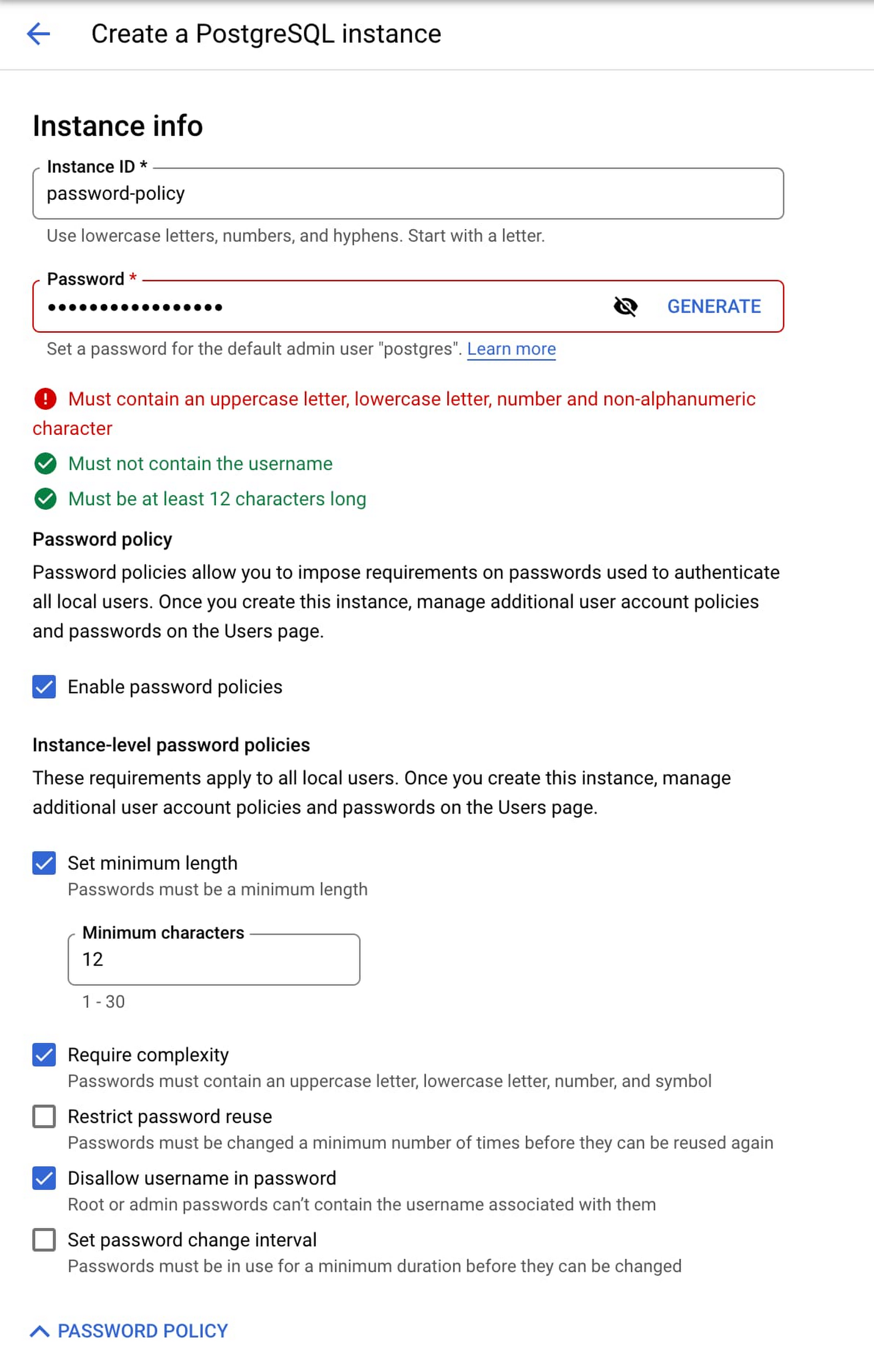
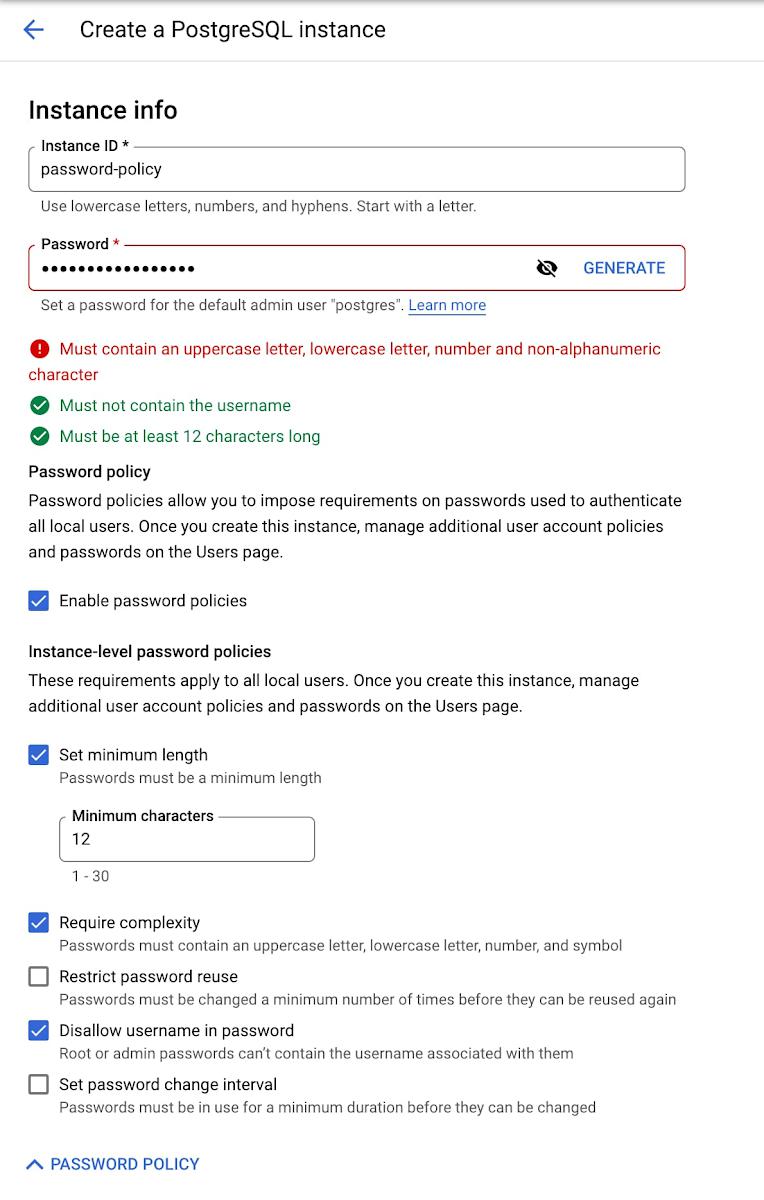
Password Validation settings on Instance level are now available for Cloud SQL for PostgreSQL. At the instance level, you can set rules to be applied to all local users (including the default postgres admin.) These configurations include:

  • Password complexity
  • Minimum number of characters required in a password
  • Number of times before a password can be reused
  • Prohibiting the use of a username in the password
  • Setting a minimum number of days after which the password can be changed

Here’s the new console user interface for the Instance Level Policy for PostgreSQL:
 

Password validation for MySQL

Password Validation for MySQL supports the existing password validation plugins capabilities and includes improvements to simplify your experience. We are introducing two levels of password settings in Cloud SQL for MySQL: Instance level password policy and User level password policy.

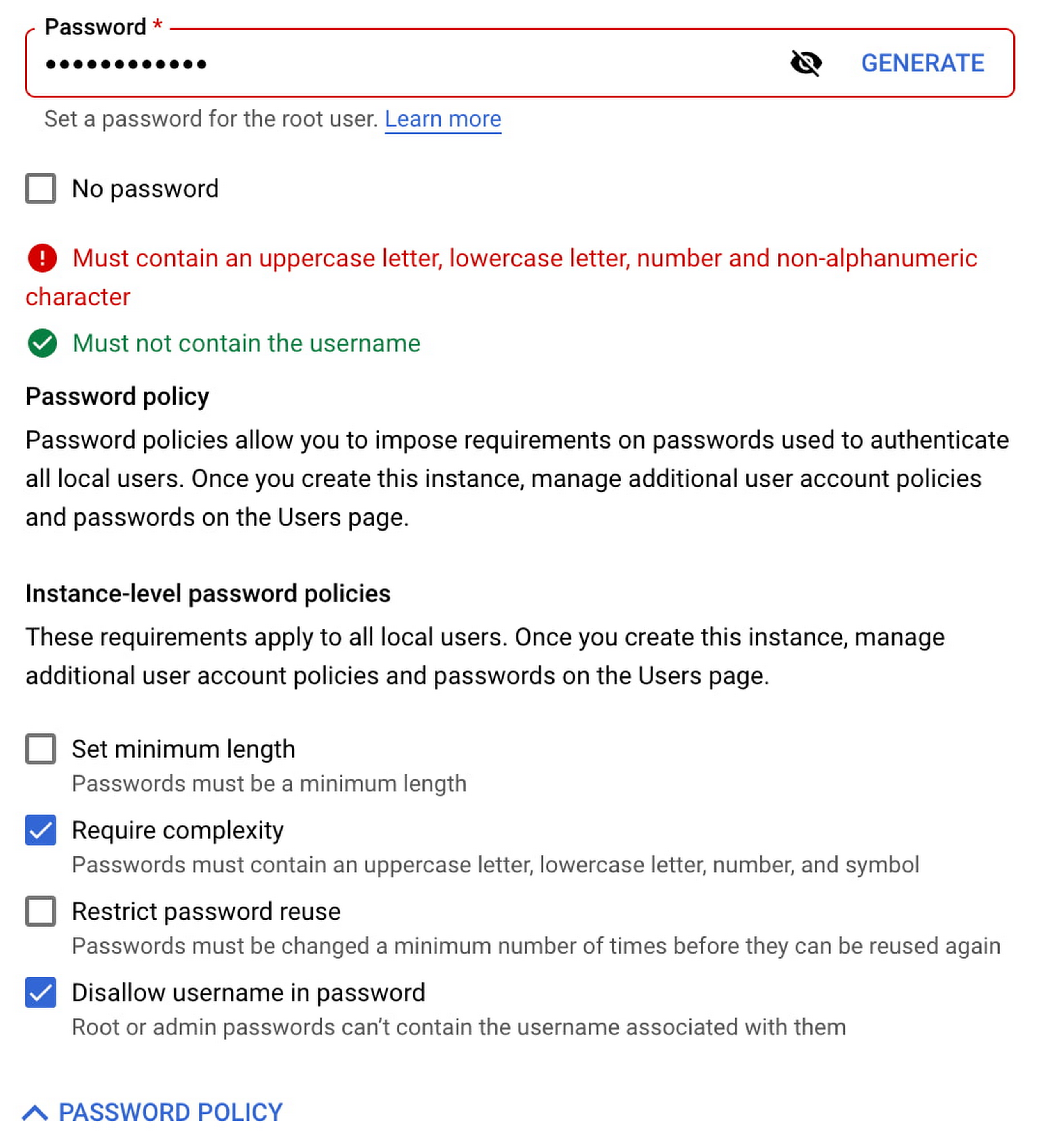
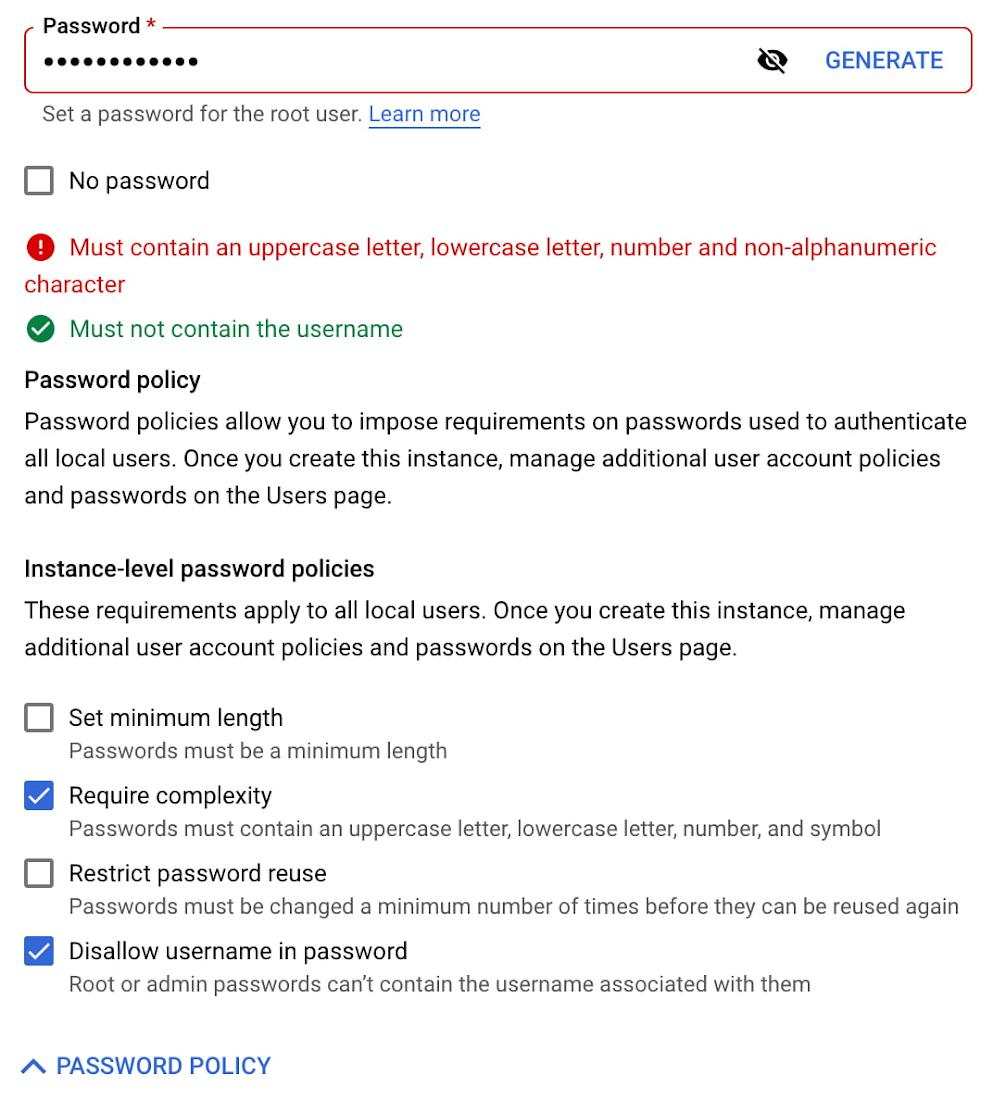
At the instance level, you can set rules to be applied to all local users (including the default root user.) These include:

  • Password complexity
  • Minimum number of characters required in a password
  • Number of times before a password can be reused
  • Prohibiting the use of a username in the password
Read More  Know More, Spend Less: How GKE Cost Optimization Insights Help You Optimize Kubernetes

Here’s the new console user interface for the Instance Level Policy for MySQL:
 

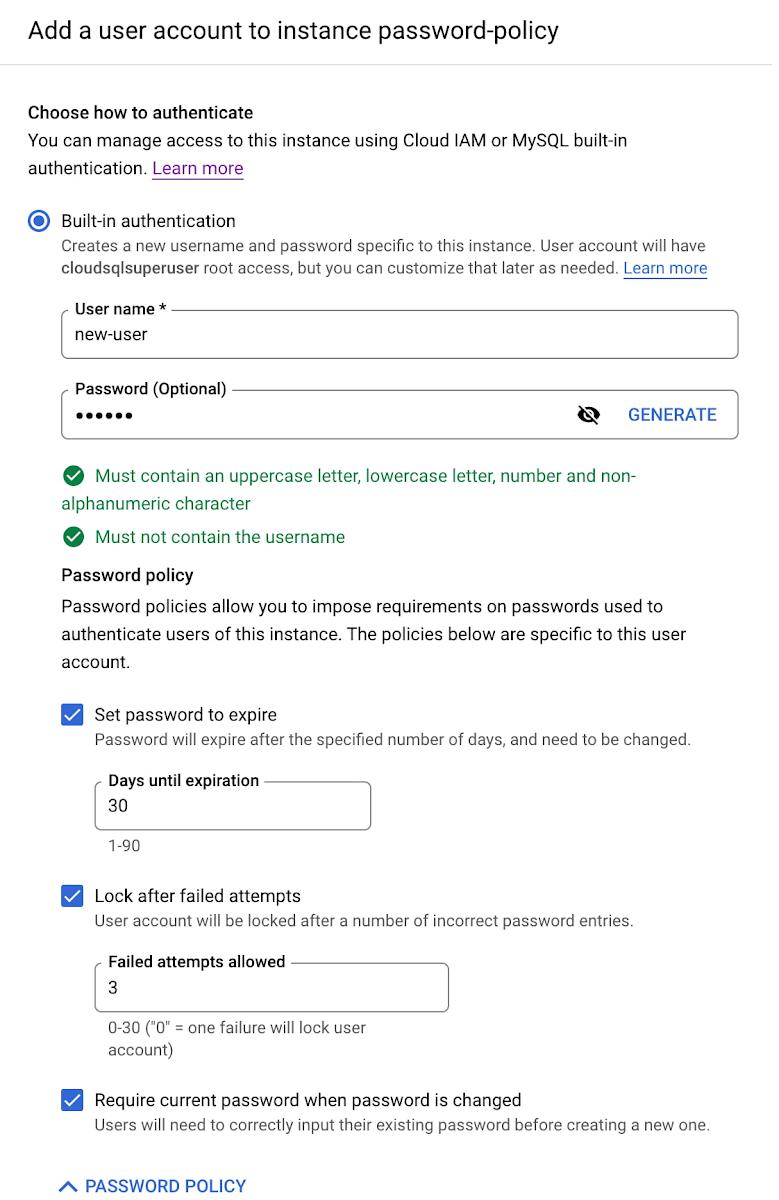
At the user level, you can set rules for a specific user. These rules include:

  • Password expiration
  • Maximum number of allowed failed login attempts
  • Password verification to require any password change to specify the current password
  • Dual password use
  • Generation of a random password

Here’s the new user interface for the User Level Policy for MySQL:
 

Using local user password validation with IAM

To understand how local user password validation works together with Cloud Identity and Access Management (IAM), let’s start by defining each of these authentication methods:

Cloud SQL integration with IAM enables Cloud SQL for PostgreSQL and MySQL end users and service accounts to connect to Cloud SQL instances using their IAM credentials. Once set up, users authenticate to the database by logging in to IAM. Behind the scenes, the service requests an authentication token from the IAM service and presents the token to the instance.

Local database users are created and managed locally within the database, enabling any person or application to access a database for data read, write, or update purposes. Database users own the objects they create in a database, such as tables, procedures, and storage locations. There are different types of users and levels of privileges that can be granted to each user.

Local database users and IAM users are complementary, and you can choose to use these authentication methods together or separately, depending on your authentication strategy.

We recommend using the centralized approach with IAM for Cloud SQL to help you better manage login access for users and service accounts to your databases. That said, there are use cases where managing local database users is still required, such as supporting legacy systems. It is important to mention that the password validation rules we are introducing today for local database users don’t apply to IAM users. The IAM service has its own password policy settings.

Read More  5 Data Trends That Will Take Your Business Forward In 2021, From Google Cloud Leaders

Local User Password Validation is now available to keep your Cloud SQL for PostgreSQL and MySQL instances even more secure and meet your compliance requirements. Learn more by reading Cloud SQL built-in database authentication and get started by creating a new instance with a password policy.


By: Maayan Rossmann (Product Manager, Google Cloud Platform)
Source: Google Cloud Blog


For enquiries, product placements, sponsorships, and collaborations, connect with us at [email protected]. We'd love to hear from you!

Our humans need coffee too! Your support is highly appreciated, thank you!

aster.cloud

Related Topics
  • Databases
  • Google Cloud
  • MySQL
  • PostgreSQL
  • Security
  • SQL
You May Also Like
Data center
View Post
  • Data
  • Public Cloud

Data Sovereignty in Spain. It’s Not Just About the Law, It’s About Efficiency

  • June 3, 2026
View Post
  • Data
  • Platforms
  • Technology

Scaling cloud and AI: Microsoft Azure’s commitment to Europe’s digital future

  • May 11, 2026
View Post
  • Data

Streamline read scalability with Cloud SQL autoscaling read pools

  • March 23, 2026
View Post
  • Data
  • Platforms
  • Public Cloud

PayPal’s historically large data migration is the foundation for its gen AI innovation

  • March 4, 2026
View Post
  • Data
  • Technology

3 obstacles to agentic AI adoption and how to overcome them

  • December 22, 2025
Points, Lines and a Question
View Post
  • Architecture
  • Design
  • Engineering
  • People

What Is The Point In Making Points?

  • November 26, 2025
View Post
  • Engineering
  • Software Engineering

Development gets better with Age

  • October 9, 2025
View Post
  • Engineering
  • Technology

Apple supercharges its tools and technologies for developers to foster creativity, innovation, and design

  • June 9, 2025

Stay Connected!
LATEST
  • 1
    You Do Not Need to Invest in the IPO of SpaceX, Anthropic, and OpenAI
    • June 10, 2026
  • 2
    The consequences of relying on AI for accurate news
    • June 10, 2026
  • 3
    Connecting AI agents with unstructured data using Google Cloud Storage MCP Servers
    • June 10, 2026
  • 4
    IBM and Google Cloud Announce Strategic Partnership to Scale AI with Human Expertise and AI‑Powered Delivery
    • June 4, 2026
  • Data center 5
    Data Sovereignty in Spain. It’s Not Just About the Law, It’s About Efficiency
    • June 3, 2026
  • 6
    Ink vs Pixels. What you miss versus what you are actually missing.
    • June 1, 2026
  • 7
    Banks race to patch new cyber vulnerabilities, and other cybersecurity news
    • May 25, 2026
  • pope-leo-xiv-cq5dam-1500.844 8
    Pope Leo XIV to Publish First Encyclical on Artificial Intelligence and Human Dignity on 25 May
    • May 22, 2026
  • 9
    Portfolio to Clients, and is Strengthened by Ongoing Project Glasswing Work
    • May 20, 2026
  • reMarkable Paper Pure 10
    Everything The reMarkable Paper Pure Actually Does
    • May 14, 2026
about
Hello World!

We are aster.cloud. We’re created by programmers for programmers.

Our site aims to provide guides, programming tips, reviews, and interesting materials for tech people and those who want to learn in general.

We would like to hear from you.

If you have any feedback, enquiries, or sponsorship request, kindly reach out to us at:

[email protected]
Most Popular
  • 1
    Scaling cloud and AI: Microsoft Azure’s commitment to Europe’s digital future
    • May 11, 2026
  • Anthropic Institute 2
    Introducing The Anthropic Institute
    • March 11, 2026
  • reMarkable Paper Pure 3
    The Quiet Revolution You Did Not Know You Needed
    • May 9, 2026
  • spain-qNO3XMQILTA-unsplash 4
    When the World Feels Unstable, Spain Remains the Calm. Here’s How to Get There Safely.
    • May 2, 2026
  • 5
    Why The CLOUD Act And Geopolitics Are Forcing A Data Sovereignty Reckoning In Europe
    • May 2, 2026
  • /
  • Technology
  • Tools
  • About
  • Contact Us

Input your search keywords and press Enter.