Researchers are already combining CPUs, GPUs, and QPUs into demonstrations of quantum-centric supercomputing.
IBM is the leader in quantum computing—but our vision encapsulates the future of computing overall. In reality, quantum will be one piece of a paradigm combining every computing tool we have available to solve problems beyond anything that’s possible today.
From our partners:
This has long been our vision, and a growing body of results from our partners at Oak Ridge National Laboratory, AMD, RIKEN, Algorithmiq, and the broader quantum community is now bringing it to life. These advances showcase how state-of-the-art GPUs, working alongside quantum processing units (QPUs), can accelerate workflows and enhance the overall fidelity of quantum computations. Rather than relying on any single architecture, these hybrid approaches demonstrate how tightly integrated CPUs, GPUs, and QPUs together unlock performance and accuracy beyond what any one of them can achieve on their own.
This is an embodiment of an entirely new compute paradigm, requiring new algorithms and new approaches to problem solving. This paradigm is quantum-centric supercomputing.
CPUs, GPUs, and QPUs
Central processing units (CPUs), graphics processing units (GPUs), and quantum processing units (QPUs) all feature unique underlying architectures that bring their own strengths to problem solving. CPUs, the workhorse of today’s computers, are capable of executing instructions on data in one or several sequences called threads, allowing us to perform a variety of mathematical operations or schedule and orchestrate complex workloads.
GPUs, meanwhile, are computer processors that can perform many simpler operations in parallel using many more threads—thousands or even millions of them. GPUs are optimized for performing fast calculations involving tensors, which are essentially multidimensional data structures where every entry has a specific location. A one-dimensional tensor, called a vector, features numbers in a column, a 2D tensor or matrix can be represented by a spreadsheet, 3D tensors can be a file with many spreadsheets, 4D would be many files each with many spreadsheets, and so on.
QPUs feature a different underlying architecture, one that stores information in the states of a quantum system. QPUs have innate access to mathematical operations beyond those that CPUs and GPUs can perform, which they run using quantum circuits. In practice, every quantum circuit can be represented into a sequence of mathematical operations using matrices that must follow a set of rules.
These operations can be performed efficiently using a QPU—but would require exponentially more space to run using classical GPUs. An operation on a 50-qubit circuit might be represented by matrices with up to 2^50 entries to accurately simulate—far beyond the abilities of any GPU.
Therefore, QPUs logically work hand-in-hand with CPUs and GPUs. A QPU can handle quantum circuits that would otherwise require far larger tensors than a GPU can handle. Meanwhile, CPUs and GPUs can take over at smaller scales for parts of a problem requiring many parallel operations of simpler tensors or traditional processing and orchestrating tasks.
CPUs + GPUs + QPUs = QCSC
In the past few years, new algorithms have emerged that rely on tensors and circuits working together to solve the most challenging problems. Among the most exciting are sample-based quantum diagonalization (SQD) techniques, which could soon improve the accuracy of large chemistry or materials science simulations.
New work from our partners at AMD, Oak Ridge National Laboratory, and a follow-on work with RIKEN implements SQD across IBM QPUs and supercomputing clusters leveraging some of the world’s fastest GPUs, demonstrating a first look at our vision for the future of computing.
Simulating chemistry with accuracy is exceedingly challenging. We can describe the overarching behavior of a system using an equation called the Hamiltonian, but actually extracting information from the Hamiltonian—say, how the energy differs between different possible configurations of the molecule—requires immensely large tensors, meaning it can only be approximated, even by the world’s best supercomputers. SQD aims to produce better approximations with the help of quantum processing.
SQD begins by encoding the Hamiltonian into a quantum circuit and running it on a quantum computer, resulting in a suggested shortlist of configurations to study. It passes this information to a classical computer, which uses these configurations to create a simpler tensor that describes the system and then diagonalize it—essentially re-organizing the tensor so we can meaningfully extract the physical information about these configurations. We pass this information back to the quantum computer, iteratively performing this process until we find the lowest-energy configurations and their associated energies.
SQD’s process of passing information between circuit and tensor representations makes it ideal for implementation across GPUs and QPUs—and recently, our partners have begun performing those implementations.
In one paper, researchers at IBM, Oak Ridge National Laboratory, and AMD presented a process to implement SQD on IBM QPUs, the Frontier supercomputer leveraging AMD and NVIDIA GPUs with the help of the OpenMP API for shared-memory multi-processing programming. They measured speedups running SQD on Frontier on the order of 100x compared to the CPU base case, with a further 1.8x to 3x speedup when incorporating the latest AMD MI300X, and MI355X GPUs or NVIDIA H100, and GB200 GPUs.
As these new workflows emerge, we can begin driving their performance forward and improving their flexibility. Building on the Oak Ridge work, we also collaborated with RIKEN to optimize the GPU diagonalization of the SQD workflow with the help of the Thrust library and the Miyabi supercluster using NVIDIA GH200 GPUs. The result is another 20% performance improvement beyond OpenMP alone, with greater flexibility to explore more advanced GPU implementations.
Using GPUs to make QPUs sing
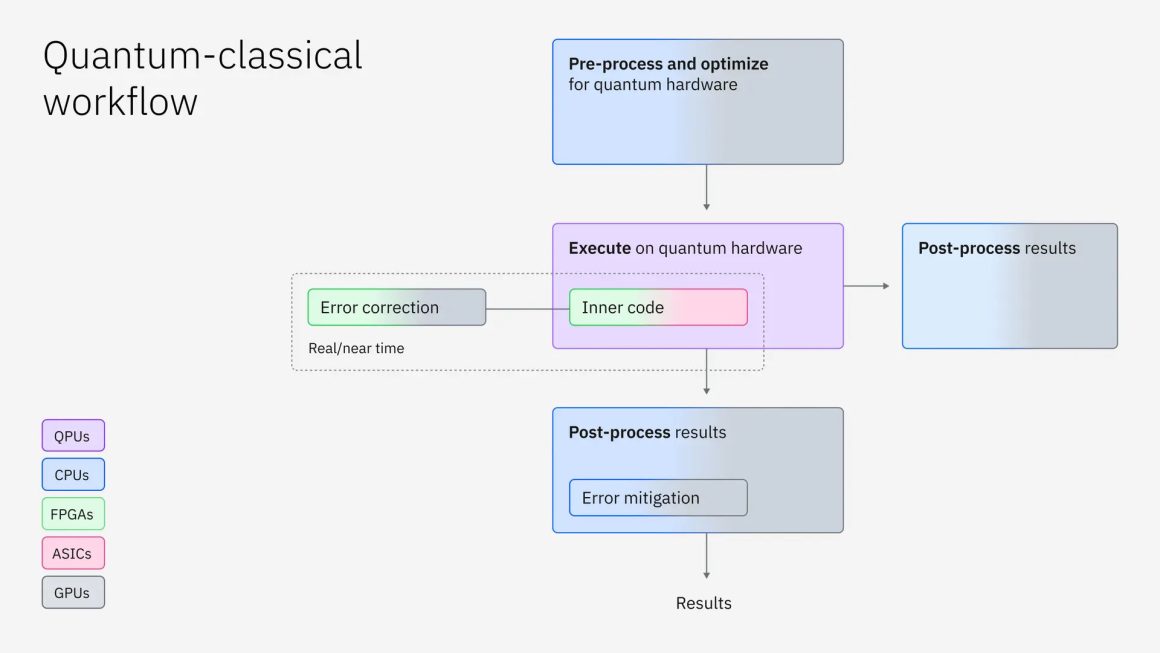
Beyond hybrid algorithms, we can even incorporate tensors, and soon GPUs, to extract more accurate results from the quantum processor. New error-mitigation techniques feature a circuit run on a noisy quantum processor, and then employ a tensor-based model to undo the effects of the noise.
In a paper released last week, researchers from startup Algorithmiq, Trinity College Dublin, and IBM explore algorithms for studying chaos in quantum many-body systems. This work employs a new class of quantum circuits called dual unitary circuits—which carry special mathematical restrictions in both space and in time—to explore systems that would otherwise be very challenging to study. This class of circuits allows researchers to simulate systems that are chaotic but which also have exact verifiable solutions, making them especially useful for benchmarking today’s quantum computers.
Crucially, this work uses new error mitigation techniques developed by Algorithmiq—now available as a Qiskit Function. The technique uses tensors to create a noise model and then inverts the model to remove the noise from the output of the quantum circuit. This work allows us to extract meaningful results for problems larger than those classical computing alone can verify, using quantum circuits to run the calculation and tensors to clean it up.
Given the use of tensors and circuits together, mitigating errors in near-term quantum workflows is an area that’s ripe for exploration using GPUs to aid QPUs. This year, we expect a variety of tensor-based error mitigation techniques to aid our users in running accurate quantum computations—further accelerated with the help of GPUs.
Meanwhile, Basque Quantum, NIST, and IBM researchers demonstrated a time crystal on an IBM quantum processor working in concert with a classical tensor network. Time crystals are systems receiving a periodic input of energy that oscillate in a stable, periodic pattern that resists attempts to perturb it.
Researchers study time crystals to advance both materials science and quantum information research, and in this case, created a two-dimensional time crystal across 144 qubits. This is among the largest and most complex ever demonstrated. The team tested the quantum results against best-available tensor network methods and used these methods to help improve the quantum execution. Given the use of tensor methods, this is the kind of work that could be extended by GPUs in the future.
A quantum-centric future
This is a glimpse at the true future of computing: not only quantum, or only classical, but quantum-centric supercomputing. The field is exploding with research combining tensors and circuits—and thus, GPUs and QPUs—to perform tasks that challenge even the best supercomputers.
That’s just the start. As we progress on our roadmap, improvements to our IBM Quantum processors will allow us to extract more accurate answers, faster. We continue to add new features to Qiskit, the open-source software development kit, so that developers can orchestrate heterogeneous workflows incorporating cloud-based or on-prem quantum, classical, and GPU processing. By the end of the decade, we will reveal a system capable of running fault-tolerant quantum computations, likely incorporating classical compute and GPUs both within the system to aid in error correction and externally to make use of the best resources available to solve the hardest problems.
The only way to participate in this future is to get started. Users should explore how to map their hard problems to circuits and tensors and begin running them on quantum computers and GPUs. The winners in this emerging era will be those who can harness the true power of quantum-centric supercomputing.
By: Ryan Mandelbaum and Jerry Chow
Originally published at: IBM Research
For enquiries, product placements, sponsorships, and collaborations, connect with us at [email protected]. We'd love to hear from you!
Our humans need coffee too! Your support is highly appreciated, thank you!